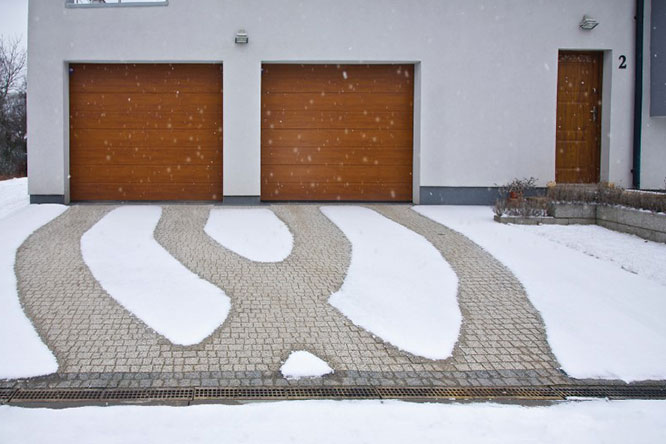
Residential Driveway Snow Melting
Our electric driveway snow melting systems provide a permanent solution to the problems caused by cold weather as they are on demand systems (temperature or moisture) that will provide you with improved safety by providing instantaneous relief from snow build up and ice formations. There is no need for costly snow melting chemicals and there are a variety of options for installation.
At a Glance: Residential Driveway Snow Melting
- Electric driveway snow melting systems provide automatic, on-demand snow and ice removal using embedded heating mats or cables installed beneath concrete, asphalt, or paver surfaces.
- Systems can be designed for full driveway coverage or economical heated tire tracks, allowing homeowners to balance performance, installation cost, and power requirements.
- Smart controls, moisture sensors, and temperature sensors help maximize efficiency by operating only when snow and ice conditions are present.
These are available as either preassembled snow melting mats or bulk cable, which are embedded directly in concrete, asphalt, or in mortar under pavers. A complete snow melting system will typically include snow melting mats or cables, a controller, and may also require additional components like a relay panel, roof or ground sensors, or cable strapping.
With over 35 years of experience we will work with you to ensure that a complete bill of materials is developed to give you the end result that you need. Our residential snow melting systems are engineered and designed for quality, longevity, and reliability. Each application is different, and our custom-tailored solutions are designed to the ASRAE standards based on parameters like heat requirement and snow fall data for local regions such as snowfall days, temperature, surface type, heat loss to ground, atmospheric loss, and perimeter insulations. These systems are custom designed with your specific parameters needed to create a snowmelt solution that exceed expectations. Also, you can find additional information on our low voltage snow melting systems which are better for older homes where the incoming electrical service isn’t big enough to handle the traditional systems.
ASHRAE classifications split snowmelt systems into three groups:
- Class I (snow free ratio 0): Designed not to melt snow while it is falling, but afterwards
- Class II (snow free ratio 0.5): 50% of snow is melted while falling, the rest afterwards
- Class III (snow free ratio 1): All snow and ice is melted while falling
We are always available if you have any questions about what you might need for your project, and to come out to the job site to do a walk through or a takeoff to make sure that all components are specified properly before everyone is on the jobsite.
Why Install Driveway Electric Snow Melting?
Electric snow melting is the most cost effective, environmentally friendly method of automatic snow removal. Our electric snow melting systems can be installed in any driveway or walkway. The system only operates when required, automatically, thus ensuring an ice and snow free area that is safe and clean. No more salt, sand, snow plows or shovels are required. We will include sensors/settings in our design that can detect when snow is falling and automatically switch on the snow melting system which will extend the life of your driveway. Hydronic systems typically have to idle to keep the fluids up to certain temperature to ensure that they work during snow fall periods, but with electric systems they only turn on when needed and get the surface to temperature very quickly.
Full Coverage vs. Tire Tracks
Full coverage means your entire driveway will cleared of snow and ice. If you’re concerned about the operating cost or the energy demand for full coverage, we can split your design into "zones" which are heated one at a time or having some come on automatically and some manually.
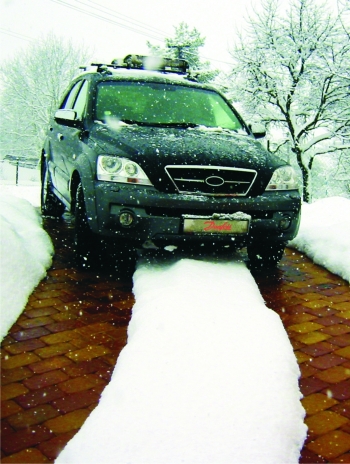
The alternative to full coverage is to simply heat tire tracks. This economical option helps users cut down on both installation and operating costs, while still providing great functionality. This works well on particularly long driveways as 2ft long mats can be spliced together for long continuous lengths.
Pre-Assembled Snow Melting Mats
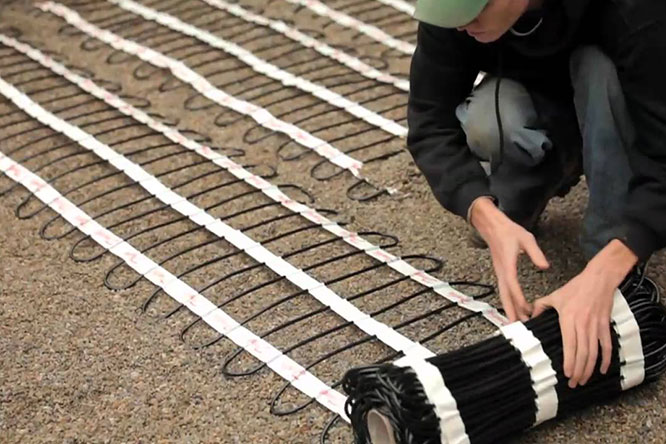
- Cable fixed to easy roll out mat for quick and easy installation
- Great for square or rectangular projects like a driveway or walkway
- Designed to maintain optimal spacing for even heating
- Twin conductor cables
- Single point connection
- Operates silently, efficiently, and safely
- Genuine twenty-year warranty
Available in 2' or 3' width and at lengths up to 60' long
Available in 120, 208, 240, 277, 480, 600 voltages.
Bulk Snow Melting Cables
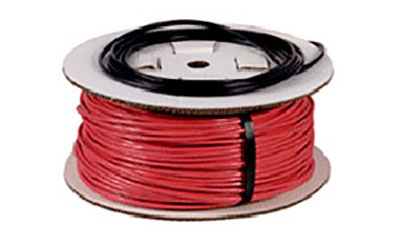
- Lower cost but requires more installation time
- Flexible option for melting snow and ice on curves, stairs, and free-form areas
- Easily attach cables to rebar or rewire with ties
- Single point connection
- Factory will cut pieces to length with 20' cold area
-
Can be designed with different spacing to increase or decrease watts per sq. ft.
- 3” centers provides 50W/sq.ft.
- 4” centers provides 35W/sq.ft.
Available in a wide range of voltages - 120, 208, 240, 277, 480, 600.
Choosing the Right Control
There are a variety of controls available for maintaining the temperature in a driveway heating system.
These systems can include:
- Housed in a weatherproof enclosure
- Senses both moisture and temperatures
- Adjustable temperature trigger point
- Expanded 30-90 min. & 2-6 hour delay off drying time
- Manual override capable
- Selectable low temperature cutoff with unique Recover module
- Super bright front panel power/activation LED indicator
- Remote control and monitor capabilities
- Two-year warranty
The controls range from simple manual devices to more sophisticated sensors that can automatically detect when snow is falling as the sensors can be positioned in the air or in the slab and each controller may handle up to 4 sensors.
Material Costs
In order to give homeowners an idea of the material costs associated with electric snow melting we have put together the following different scenarios which gives a basic outline of the material costs for these type of projects. While every project is different and our solutions are custom, this will allow customers to determine if this type of solution is in their budget. For a more complete overview of your project please contact us so that we can review your specific needs.
Please note: These costs are for material only, installation can cost anywhere from 50% to 100% of the material cost depending upon many different factors.
Concrete Pad Estimated Cost, 240VAC
6’ x 10’ area, no expansion joint, based on 50W/sq.ft, 7” spacing-MI Cable
|
| MI Cable |
$99.00/sq-ft |
| Controls - 2-circuit GFPE panel and controller |
$1,916.00/ckt |
Driveway Estimated Cost, 240VAC
10’ x 30’ paved driveway using mats, 50W/sq-ft
|
| Snow Melt Mats |
$13.00/sq-ft |
| Controls - 4-circuit, single moisture/temp sensor |
$1,165.00/ckt |
Driveway Tire Tracks Only, 240VAC
10’ x 30’ paved driveway, (2) 3’ wide tracks using Mats, 50W/sq-ft
|
| Snow Melt Mats |
$14.00/sq-ft |
| Controls - 2-circuit, single slab moisture/temp sensor |
$1,869.00/ckt |
Power Requirements
To melt snow efficiently in a residential application, electric heating cable will need to deliver about 40 to 50 watts of heating power per square foot of slab surface depending upon the material. Homeowners may need to upgrade their circuit panel or install a separate circuit to supply enough power depending on the dimensions of the area to be heated.
The table below is a basic outline of the required amperage needed to operate different sized systems at different voltages for you to review. It is important to keep in mind that most newer homes come with a 200 Amp service installed and many older homes only have 100 Amp services. What this means is that you should contact your electrical contractor to discuss the cost of upgrading your electrical service to be able to effectively manage this increased load, as it can be quite costly.
|
Volts - Single Phase |
|
120 V |
208 V |
240 V |
277 V |
480 V |
| 500 sq/ft |
208 amps |
121 amps |
104 amps |
90 amps |
52 amps |
| 1000 sq/ft |
416 amps |
242 amps |
208 amps |
180 amps |
104 amps |
| 1500 sq/ft |
624 amps |
363 amps |
312 amps |
270 amps |
156 amps |
| 2000 sq/ft |
832 amps |
484 amps |
416 amps |
360 amps |
208 amps |
Frequently Asked Questions
Quick Links
How do residential driveway snow melting systems work?
Electric snow melting systems use heating mats or cables embedded beneath the driveway surface to generate heat and melt snow and ice before accumulation becomes a problem. Control systems monitor temperature, moisture, or both and automatically activate the heating elements when conditions require. Because the heat is applied directly beneath the surface, snow removal occurs without the need for shoveling, plowing, or chemical deicers. The result is a safer, more accessible driveway throughout the winter season.
What installation options are available for a driveway snow melting system?
Snow melting systems can be installed using either pre-assembled heating mats or bulk heating cable. The heating elements can be embedded in concrete, asphalt, or mortar beneath pavers, making them suitable for both new construction and many renovation projects. Heating mats provide faster installation and consistent cable spacing, while bulk cable offers greater flexibility for curved driveways and custom layouts. The most appropriate option depends on the driveway configuration and project budget.
What is the difference between full driveway coverage and heated tire tracks?
Full coverage systems heat the entire driveway surface, keeping the entire area free of snow and ice. Heated tire track systems only warm the portions of the driveway where vehicle tires travel, significantly reducing installation and operating costs. Tire track systems are especially popular for long driveways where full coverage may not be practical. Both options improve winter accessibility, but full coverage provides the highest level of convenience and safety.
How much electrical power does a driveway snow melting system require?
Power requirements depend on the size of the heated area, the desired snow melting performance, and the operating voltage. Most systems are designed to provide approximately 40 to 50 watts per square foot to effectively melt snow and ice. Larger driveways may require dedicated circuits or electrical service upgrades, particularly in older homes with limited service capacity. A professional power analysis should be performed during the design stage to ensure the home has adequate electrical capacity.
What controls are used to operate driveway snow melting systems?
Control options range from simple manual switches to fully automated systems that sense both temperature and moisture. Advanced controllers can use slab-mounted or aerial sensors to detect winter conditions and activate the system automatically. Many systems include adjustable activation temperatures, post-storm drying cycles, manual override capabilities, remote monitoring options, and multi-zone control. Proper control selection improves efficiency by ensuring the system operates only when necessary while maintaining reliable snow and ice protection.